Mostrando entradas con la etiqueta bike lanes. Mostrar todas las entradas

sábado, 22 de septiembre de 2018

A Car Crash....in a Bike Lane

Crashed cars in a bike lane.
 On my way home this evening I encountered these two cars crashed into each other in Carrera Septima's bike lane, across from Independence Park and almost beside the CAI police station.

These cars have seen better days.
My first thought was to wonder what the cars were doing in the bike lane when they crashed, or whether they smashed together somewhere else and the skidded into the lane, hopefully not taking any cyclists with them. (I'm not sure how long previously the accident had happened, but I saw no ambulances, so hopefully nobody was seriously injured.)

The second thing which struck me about the crash scene was the lack of measures to prevent cyclists from crashing into the smashed cars. On the other hand, someone had very thoughtfully placed reflectors in the street to warn drivers against hitting the cars in the bike lane.
Reflectors thoughtfully placed to prevent other cars from hitting the smashed cars in the bike lane.


By Mike Ceaser, of Bogotá Bike Tours

sábado, 30 de junio de 2018

The Pleasures of Shared Bike Lanes


Should bicyclists on this busy avenue in south-central Bogotá, near the Primero de Mayo, feel privileged? After all, this avenue has a special bike/bus lane, as well as 'bike boxes' for waiting safely at intersections.

But the reality doesn't match the theory. On the pavement, here's the cycling experience:

Lots of bicyclsts....
But lots of other vehicles in the exclusive bike/bus lane.
Strict exclusivity!

Can you spot the bicycle?


By Mike Ceaser, of Bogotá Bike Tours

domingo, 22 de abril de 2018

116 Street's New Bike Lane

Cyclists pedal up 116 Street's new bike lane - several wearing pollution masks.
Bogotá did a nice job on its newest bike lanes - but if only they were connected.

The Cicloruta de la Calle 116, inaugurated last week on International Bicycle Day, is nicely laid out,
A well-designed intersection.
protected from motorized traffic, has smooth road crossings and even some views. And it has not been invaded by street vendors - as of Friday, anyway.

Still, the lane shows some of the symptoms of the ills of Bogotá cycling: A lot of the cyclists wear facemasks, in probably futile attempts to filter out diesel particles. And, at Carrera 15 the lane simply ends, with no connection to another lane. (An adjoining street does have a meaningless sign: 'Shared use with bicycle priority.') The lane then reappears at Carrera 19 and continues to Carrera 50, for a total of 2.4 kms.

Cyclists, including Rappi messengers, wait to cross a street. But that thing on the left doesn't look like a bicycle. 
At Carrera 15, the lane simply ends.
The neighborhood's bike lanes seemed quite busy, at least on the late afternoon when I rode them. A government study reported that some 82,000 cyclists ride thru area every day. The number, while large, does seem believable. Which shows that bicycles are carrying a significant number of Bogotá commuters, altho the city's worsening traffic jams show that car use has increased as well.

When Mayor Enrique Peñalosa inaugurated the lane last week he said that Bogotá now has 500 kilometers of bike lanes, with 20 more projects under construction, which will total 40 additional kms of lanes.

Pedicabs near the lane. The mayor said that gasoline-powered
 cabs would be banned from the lane.
During the inauguration, Peñalosa also said that motorized bicitaxis would be banned from the new lane. Hopefully that will be enforced, and not only on this lane, but all of Bogotá's bike lanes. But he wants to allow pedal-driven cabs to use the lanes. Pehaps this also means that the city will finally crack down on the motorized bicycles, called bici-motos, which cruise the bike lanes as if they were bicycles.


Passing of the Autopista Norte, one long traffic jam.

And on my way back south, bike lane troubles:
Ills of Bogotá's bike lanes: On the way south, cycling down a sidewalk amids pedestrians.

Also on the way back south, an SUV driver doesn't think twice about stopping on a bike lane.
Blog by Mike Ceaser, of Bogotá Bike Tours

miércoles, 29 de noviembre de 2017

Does the Motor Make the Bike?

Can you tell which one is the bicycle?
Colombia, the nation of magical realism may be the only place where a motorized, three-wheeled vehicle apparently qualifies as a 'bicycle'.

What's the difference? A motorized bicycle waits on
the sidewalk, while a regular motorcycle passes on the street. 
At least, that's the way it appeared the other day on Carrera Septima's bike lane, which this loud, polluting monstrosity was sharing with cyclists, as police watched apathetically.

For the record, the motorized bicitaxis, which I understand are illegal wherever they are, are, tragically, replacing the traditional pedal-powered bicitaxis. The vehicles' two-stroke engines pump out more pollution than do most cars.

However, it's no big deal. After all, the equally loud and polluting bicimotores have long been invading our bike lanes, in the face of police and other authorities' total apathy.

In the case of the bicitaxi, I chased after it, but it roared down Carrera Septima, charging thru red lights along the pedestrian-only avenue. Do you think anybody cared?

By Mike Ceaser, of Bogotá Bike Tours

martes, 26 de septiembre de 2017

Making Cycling Safer: It isn't Easy

'Not One More Death!' Cyclists protest
the recent death of a Bogotá bicyclist.
Understandably, this year's Bogotá Bike Week is paying lots of attention to the problem of cyclist fatalities. After all, just recently two Bogotá bicyclists were killed by accidents on two consecutive days. And so far in 2017, some 45 cyclists have died on Bogotá streets. In contrast, in New York, which has about the same population and also a public bicycles program, about 15 cyclists die each year.

I'm writing this from northern California, where I'm visiting my
A video by the El Espectador newspaper
chronicles the number of Bogot'a cyclists
killed annualy, generally more than 50.
parents in a suburb east of San Francisco. Bicycling around here makes starkly clear how Bogotá falls short of being a cyclist-friendly city. Unfortunately, the improvements it needs aren't easy.

The 'Cicloruta' on Calle 13, in Bogotá.
Can you see it amidst all those pedestrians?
Safe, pleasant, useable bike lanes: Bogotá has some of these, and the city is improving. But many Bogotá bike lanes are merely lines painted on sidewalks, where cyclists must dodge around pedestrians, delivery drivers and cars. Other bike lanes have potholes or are blocked by signposts.

In contrast, in northern California, most bike lanes are wide, well-maintained and on streets, where
A California bike lane. Nice -
but where are the cyclists?
they actually take space away from cars.

A bicyclist (behind taxi/red arrow) tries to cross a
Bogotá intersection blocked by cars which ran the red light.
Cautious, courteous drivers: Unfortunately, many Bogotá motorists behave as tho they are the only ones with any rights. That's why you see pedestrians waiting interminably at crosswalks.

(When I block the cars to give an old lady a chance to cross, motorists insult me for it.)

Cycling across an intersection often becomes a game of chicken with drivers who run red lights or
Seldom seen in Bogotá: California cars
stop and wait to let a pedestrian
cross a street.
ignore stop signs and believe that neither laws nor common decency apply to them.

In contrast, here in the Bay Area when I even APPROACH an intersection drivers stop. Is something wrong? I wonder. No, they're waiting for me to cross. Is this out of courtesy, or because they're terrified of getting sued? Does it matter?

Of course, cyclists violate lots of traffic rules. But the general atmosphere of chaos and lack of civility on Bogotá streets makes a cyclist shake his shoulders and ask 'Why obey rules, if nobody else does?'

A Bogotá bus appears to aim its smokey
exhaust at a pedestrian.
Breathable air: In Bogotá, every time a bus, van or truck passes me, I hold my breath, half expecting to be blasted with diesel smoke. In Bogotá, even many cars belch fumes because they lack a catalytic converter or filters. As any Bogotano knows, in a congested spot, you can literally TASTE the air pollution.

Besides the obvious health impacts, this just makes bicycling unpleasant. In California, which has some of the world's strictest emissions laws, even in congested areas I barely sense fumes at all.

The first of these problems requires an engineering fix, and city planners appear to be improving: All the new bike lanes I've seen are on streets.

But the other two issues involve culture, which is tougher to change. Perhaps less apathetic (and less
New York City bicycling accident
rates have fallen steeply.
(Graph: N.Y. D.O.T.)
corrupt) transit police could help, as might public relations campaigns. But as long as the every-man-for-himmself credo rules, cycling, driving and walking Bogotá's streets will be dangerous and frustrating.

Yet, for all that, Bogotá has many more cycle commuters than do northern California's suburbs - and perhaps even more than does bike-friendly San Francisco.

That's why I'm becoming convinced that making cycling pleasant and making it popular are two very different - but related - issues. Fixing these troubles will lure onto two wheels only those people who already would like to bicycle, but are afraid to. To get more people to WANT to cycle will require  more fundamental social changes.

By Mike Ceaser, of Bogotá Bike Tours

miércoles, 6 de septiembre de 2017

Peñalosa's Experimental Bike Lanes

This broad new bike lane on Carrera 7 connects the city center
 to the Centro Internacional.
Mayor Peñalosa has created a number of new bike lanes - some better than others,

The pedestrianized secion of Carrrer 7 has finally been connected to the Centro Internacional and the
Until recently, the lane looked like this:
protected by temporary barriers.

Carrera 13 bike lane with a full-scale lane on Carrera Septima, complete even with tiny and annoying speed bumps.

Other lanes are being phased in, with heavy plastic barriers marking their paths until something concrete is installed.

While bike lanes mean more riders, they also generate complaints from drivers, who feel deprived of road space they believe belongs to them. Yet, from what I've seen, these proposed lanes are on quieter streets where the space won't be missed. And grumbling drivers ought to imagine how much worse congestion would be if each of those cyclists were instead driving a car.

This letter writer complains about bike lanes taking away space from cars, but forgets that bicyclists also open up room in cities.
And Bogotá's bike lanes get little respect:
Even Bogotá's best bike lanes get little respect.
These drivers thought this bike lane offered convenient parking.
And the provisional lanes even less respect:

A glance at Bogotá's traffic congestion shows that it's not the fault of bicycles or bike lanes:
A daily travail in Bogotá. Not the fault of bicycles.

sábado, 10 de junio de 2017

A Tale of Two Ciclorutas

Pedaling past congested cars on Carrera 11's bike lane.
Rush hour on the bike lane. 
The Cicloruta, or bike lane, which runs up carreras 13 and 11 from the Museo Nacional to Calle 100 represents and best and worst in Bogotá bicycle infrastructure. So much, that it's more accurately two bike lanes stitched together.

The 18-block stretch between calles 82 and 100 are wide, clear and smooth: great for cyclists' self-esteem - particularly when one is sailing past cars jammed against each other. Perhaps the sight of us free and fast cyclists will persuade a few drivers to emerge from their steel cans.

But even on the bike lane, cars cause problems. Here, waiting for a traffic jam to clear.
South of Calle 82, riding around a car
stopped across the sidewalk bike lane.
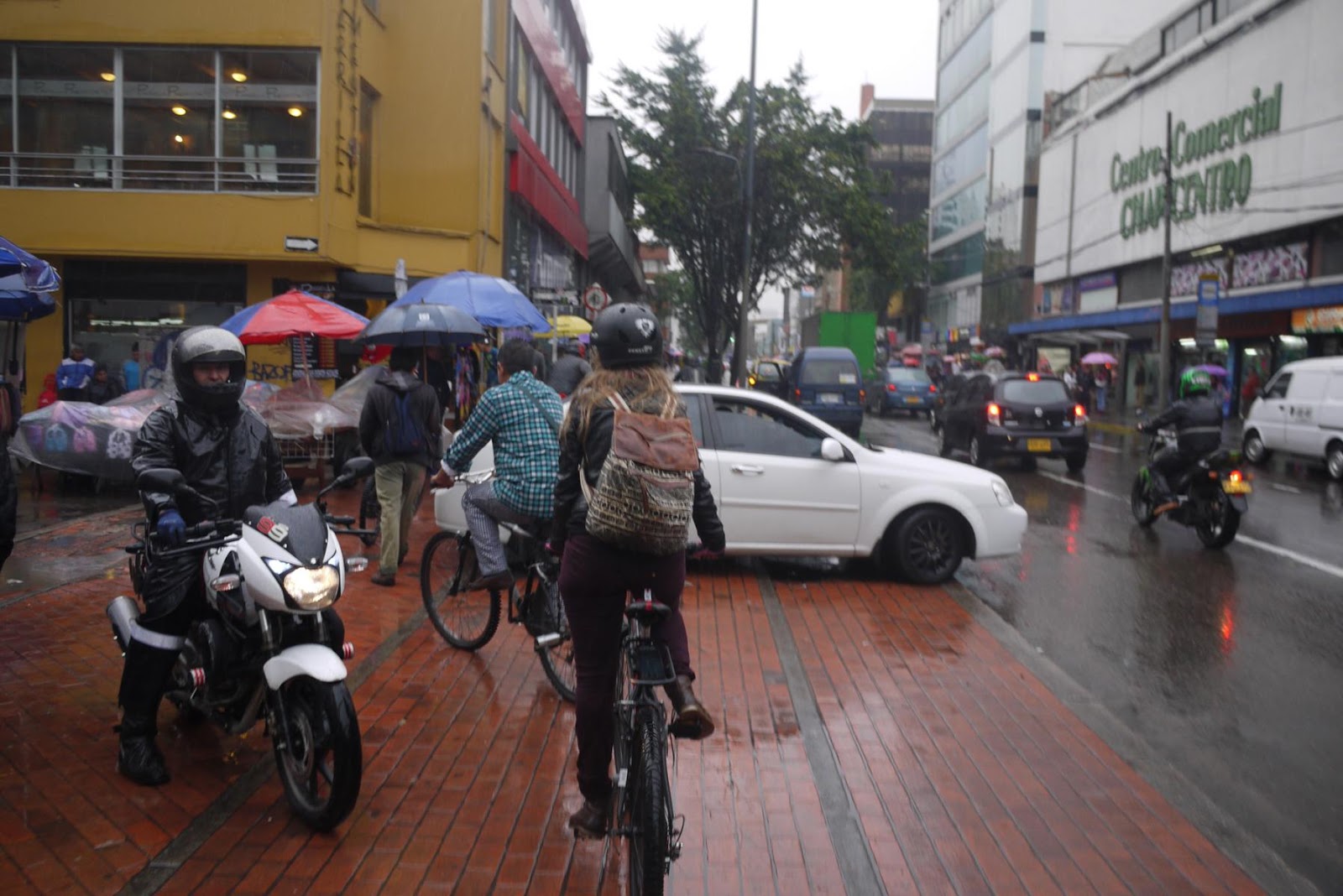
South of 82nd street, however, the bike lane shifts onto the sidewalk, where cyclists must dodge pedestrians and delivery vehicles, not to mention cars waiting at stop signs and the occasional dog. As bad as it is for the cyclist, this arrangement must be more miserable for the poor pedestrian, who steps across the sidewalk only to have a furiously pedaling commuter rush past them. And the cyclist feels like an interloper, a bully rushing between pedestrians and swerving around them.


Sidewalk riding can be crowded.

A ´puddle and broken pavement.

Amphibious cyclilng, anyone?

By Mike Ceaser, of Bogotá Bike Tours

viernes, 28 de abril de 2017

The Importance of Pruning

Can you see the lane below those branches?
 The bike lane on Calle 39 created last year was a useful addition for Bogotá cyclists, asi it connects the 11th-Street bike lane (and the Parque Nacional) to Teusaquillo and the Parkway. (That it is one of the few bike lanes which take space from cars instead of pedestrians is another positive.)

Since then, however, the lane has been neglected. On its first segment, to Caracas Avenue, the median strip's trees have extended their branches across the lane, and into cyclilsts' faces - a situation which would never be tolerated in a lane for cars.


This bicyclist didn't even use the new lane.
Now it's safe to return to the lane.


By Mike Ceaser, of Bogotá Bike Tours

lunes, 12 de septiembre de 2016

Steps Forward, Steps Back

In the year or so since my camera broke and I got too busy to blog, Bogotá has moved forward on some bike issues - and backward on others.

They've added bike lanes - some of which are actually useful and well-used.

A new bike lane in Teusaquillo actually demands respect for cyclists.

But here's what traffic does to the lane. (Spot the cyclist trying to cross Avenida Caracas.)

And which transit genius decided that nobody would ever want to enter the lane from the west?

And here's a lane along Calle 11 in north Bogotá. It's satisfying pedaling past cars stuck in traffic.


But I just wish they'd keep the motorized bikes out of the lanes...

More to the south, the lane still runs on the sidewalk. Here's a rare sight: a bicycle traffic jam.
And, finally after years satisfying what's a personal issue of mine, after years of delay and mulitple complaints from cyclists, the city's transit geniuses finally decided that cyclistas had the right to safely cross this street behind the Central Cemetery. Until they retimed the lights, giving cyclists and pedestrians time to cross. They even added a signal for cyclists.


Green means go for cyclists.
But that doesn't stop cars from parking in the bike lanes.
Previously, as soon as the cars driving north across the bike lane stopped, other cars immediately starting turning left across the lane. That left no time between car traffic for bikes or pedestrians to cross, generating constant conflicts between cyclists and motorists. 

But the news isn't so great for public bikes. 

A few months ago, then-new Mayor Enrique Peñalosa - who campaigned for mayor on a bike - terminate the IDRD's bike lending programs on Carrera 7, in the Universidad Nacional and Parque El Virrey. Apparently, the program cost too much. 

The program was, irrationaly, limited. You coul not pick up a bike in one part of the city and drop it off in another, for example. But it was Bogotá's only public bikes lending program. 

That was then: Public bikes on Carrera Septima.
Where are they now? Rusting away somewhere.
And the city's much-vaunted general public bikes program, which Mayor Petro issued the contract for last year?

Not a single bike has hit a street. That's not surprising, since neither the Colombian nor the Chinese companies which one the contract had experience with bicycles, the Colombian partner had been involved in two corruption scandals, and the contract's business model was totally unrealistic. (The contractee was supposed to pay the city, whereas just about everywhere else, public bikes lending schemes lose money and are either subsidized by their cities or receive lots of advertising income.

By Mike Ceaser, of Bogota Bike Tours