Mostrando entradas con la etiqueta cycling. Mostrar todas las entradas

sábado, 10 de junio de 2017

A Tale of Two Ciclorutas

Pedaling past congested cars on Carrera 11's bike lane.
Rush hour on the bike lane. 
The Cicloruta, or bike lane, which runs up carreras 13 and 11 from the Museo Nacional to Calle 100 represents and best and worst in Bogotá bicycle infrastructure. So much, that it's more accurately two bike lanes stitched together.

The 18-block stretch between calles 82 and 100 are wide, clear and smooth: great for cyclists' self-esteem - particularly when one is sailing past cars jammed against each other. Perhaps the sight of us free and fast cyclists will persuade a few drivers to emerge from their steel cans.

But even on the bike lane, cars cause problems. Here, waiting for a traffic jam to clear.
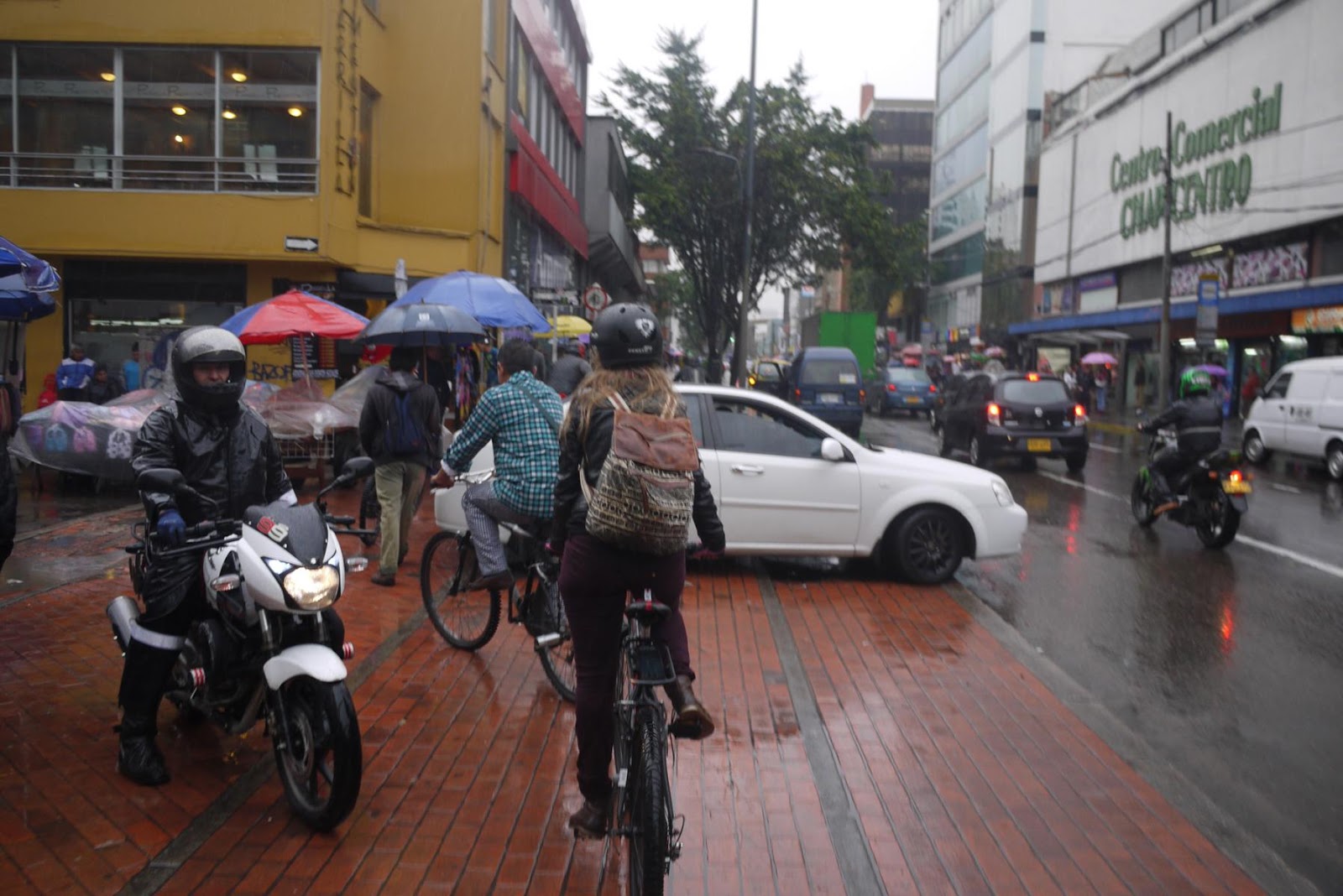
South of Calle 82, riding around a car
stopped across the sidewalk bike lane.
South of 82nd street, however, the bike lane shifts onto the sidewalk, where cyclists must dodge pedestrians and delivery vehicles, not to mention cars waiting at stop signs and the occasional dog. As bad as it is for the cyclist, this arrangement must be more miserable for the poor pedestrian, who steps across the sidewalk only to have a furiously pedaling commuter rush past them. And the cyclist feels like an interloper, a bully rushing between pedestrians and swerving around them.


Sidewalk riding can be crowded.

A ´puddle and broken pavement.

Amphibious cyclilng, anyone?

By Mike Ceaser, of Bogotá Bike Tours

miércoles, 30 de septiembre de 2015

Laws for Biking?

It has an engine, burns fuel, belches smoke and goes vroom. So is it a bicycle or a motorcycle? 
Colombian lawmakers are considering pro-cycling laws right now - but unfortunately they likely won't get much priority - and lots of opposition.

A bici-motor in a downtown bike lane.
One would prohibit bicycles equipped with motors from bike lanes. It might just seem like common sense that a bicycle with a motor is, by definition, a motorcycle. However, because the motors' have less than 50 cc of displacement, the city's motor vehicle laws don't cover them, That's despite their being very noisy and often generating more pollution than a car, since their two-stroke engines burn oil.

One complication with banning the motorized bikes from bike lanes is distinguishing them from electric bikes, which are also motor-powered, but don't pollute or make much noise and go much slower than gasoline-powered motor-bikes. The electric bikes aren't a problem, the gasoline-powered ones are.

In any case, if this legislation nears becoming law, you can expect the motor-bikes' makers and users to scream that barring them from bike lanes violates their human rights. But that's not all. Even when they're on the street, they should be equipped with anti-pollution devices and their riders should be licensed.

A second law, in Congress, is intended to promote cycling - actually has some good things: It would provide some financial incentives, albeit small ones, for frequent cyclists, and would also give extra time off for public employees who commute by bike.

Unfortunately, the benefits are slight compared to the huge subsidies given to motor vehicles, such as free parking and subsidized fuel - not to mention the non-stop onslaught of pro-car propaganda.

The law's most important benefit might be a change of mentality legitimizing bike commuting in a climate where many workplaces provide no place for bike parking, much less showers or a changing room.

Businesses will undoubtedly oppose this legislation, as more costs and government regulation. This despite the fact that more bike commuters means healthier employees, and each worker who switches from driving to cycling can mean big savings in less parking.

By Mike Ceaser of Bogota Bike Tours

domingo, 19 de septiembre de 2010

Is This Really How to Get People onto Bikes?


The other day, this group of city employees pedaled up Seventh Ave. to the National Park, about 40 blocks. On a typically smoggy morning, they rode up Seventh St. amidst belching buses and cars which - at least normally - would be trying to run them off the road.

This was the municipal government's campaign, called Bicivilizate, to promote bicycle commuting amongst its employees. On the one hand, it's a small miracle that the Samuel Moreno administration is paying any attention at all to bicycles. Unfortunately, however, this attention isn't very productive. I'd like to know how many of last Friday's pedalers dusted off that old bike the next day, and how many told themselves: 'Thank God that death-defying experience was only a one-time thing!'

As well-intended as it may have been, one-time stunts like this won't bring the sorts of mindset changes necessary to make bicycle commuting grow. What I'd really like to know is whether these employees' offices provide secure bicycle parking, whether they have showers and lockers available and whether they provide any subsidies comparable to the free parking they likely offer car drivers.

Most of all, I'd like to know whether a person who does ride to work is met with respect or teasing and condescension.

At the risk of sounding like a broken record, it's worth repeating that what Bogotá needs is real control of pollution, respect from car drivers for cyclists and pedestrians and lots of traffic calming measures - not to mention that holy grail traffic rationalization: a congestion tax. This blog by Mike, of Bogota Bike Tours.


How'd you like to pedal behind this bus?