Mostrando entradas con la etiqueta Ciclovia. Mostrar todas las entradas

domingo, 4 de febrero de 2018

Bullfighting Reroutes La Ciclovia

'Turn right' during the bullfighting season.
During the past several Sundays and the next ones, Bogotá's Sunday Ciclovia is making an obligatory detour - for non-cycling motives.

Riding past a mural on Calle 26.
This is bullfighting season, which can mean big protests, which sometimes spill into violence. papa bombas and tear gas, or to keep people away from the plaza, or to give police freer action, the Ciclovia which normally goes along Carrera Septima, now instead detours west along Calle 26, jogs through the Teusaquillo neighborhood, and then turns right again to rejoin La Septima two blocks south of the Parque Nacional.
Whether it's to protect cyclists from
Watch out! Pedaling past a multi-bike accident
on Calle 26 underneath Carrera 13.

Some of the new route, such as 26th Street, was already part of La Ciclovia - but not obligatory for those riding along La Septima. The temporary route exposes more people to the delights of Teusaquillo, while depriving them of landmarks such as the Torre Colpatria, Museo Nacional and the Centro Bavaria. It also adds more risk. In three weekends rides I've witnessed the aftermath of two accidents in Calle 26's dark underpass.

Calle 26 passes by the famous
'Beso del Bronx' mural.
Bullfighting seems like a throwback to medieval times. Bullfighting does involve courage and skill, but any 'entertainment' involving stabbing animals to death just doesn't fit in a society which claims to value life. As for the protesters: More power to them. However, they ought to turn they attention and protests toward things like cockfighting and factory farming, which are much crueler and affect many more animals.

But, even if one stays agnostic about bullfighting, the fact is that Bogotá is expending tremendous amounts of money and resources to defend the pastime of a small minority of people, even if they do happen to be wealthy, conservative and influential. Besides inconveniencing the city's cyclists, Bogotá has also called out more than 3,000 police to keep the peace around the bullfighting stadium - police who must be paid and outfitted at taxpayer expense, and who could better be employed preventing crime.

Right or wrong, bullfighting inevitably generates protests, all of which cause huge inconvenience and expense for Bogotá. Why not leave all of this behind? Lots of other forms of enterntainment are available.

Cyclling along some Teusaquillo streets not normally part of La Ciclovia.


By Mike Ceaser, of Bogotá Bike Tours

miércoles, 25 de febrero de 2015

Armored Invasion of La Ciclovía!


This Sunday, this armored car driver decided that La Ciclovía provided a convenient route to wherever he was heading. The folks in charge of La Ciclovia, who presumably are there to defend cyclists' rights and safety, either didn't notice or didn't care.

Unfortunately, the incident is symptomatic of the way motorized vehicles, particularly motorcycle, invade cyclists' territory.


Blog by Mike Ceaser, of Bogota Bike Tours

lunes, 21 de abril de 2014

Four Wheels More Important Than Two?

Two cyclists Sunday near Calle 26. La Ciclovia was cancelled for drivers' benefit, yet car traffic was very light.
Ousted Bogotá Mayor Gustavo Petro may not have done as much as many of us had hoped for cycling - but he did at least sing bicycling's praises, and give bikes some priority. That's most evidenced on Seventh Ave, which Petro pedestrianized and added a bike lane.

Skaters on 26th Street on
Good Friday's Ciclovia.
But bicycling's status may be dropping under the post-Petro placeholder mayors. Bogotá is famous for its Sunday-Holiday Ciclovia, when some main streets and avenues are shut down to cars. This Sunday, however, city officials surprised us by canceling La Ciclovia so as not to inconvenience holiday drivers returning to the city.

Bicycling down Ave. Septima
during last Thursday's Ciclovia.
Admittedly, they did schedule two Ciclovia's last week, on Thursday and Friday. And, with many Bogotanos either out of town or celebrating Easter with their families, the cyclist turnout was light over Easter.

However, the predicted rush of motorists into the city didn't seem to appear at all - or at least until after La Ciclovia had ended at 2 p.m.

Would they have taken this Snday's Ciclovia away  if Petro were still mayor? I doubt it.

Bicyclists share Ave. Septima with a bus on Sunday,
when the avenue would normally be closed for La Ciclovia.
Ciclovias have been cancelled previously to keep those annoying bicyclists out of the way of drivers returning to the city. It's symptomatic of transit planners' mindset that cars are important, while bicycles are nothing more than recreational vehicles whose primary duty is to not inconvenience motorized vehicles.

I hope we won't lose Petro's unfortunately few contributions to urban cycling: the on-street bicycling lanes and the pedestrianization of Ave. Septima.

Bicyclists on the Ave. Septima Ciclovia. Will the mayor reopen it to cars and eliminate the bike lane?
By Mike Ceaser, of Bogotá Bike Tours

miércoles, 25 de diciembre de 2013

A Ciclovia We Don't Need

A scene on the Ave. Septima Ciclovia today. 
 Some say that Bogotá's Sunday/holiday Ciclovia is the city's 'beach', with its more than 100 kms of car-free streets. But today it seemed that most bogotanos were at Colombia's real beaches (or at home sleeping off last night's partying). La Ciclovia, which often hosts between one and two million bicyclists, walkers, joggers and skaters, instead looked rather barren.

Does it really make sense to mobilize and pay the small army of police and Ciclovia monitors - who undoubtely would rather be with their families or still in bed -  for the few who venture out on Christmas or New Year's Day? Couldn't the money do more for cycling spent a different way?

This is particularly true on a day when motorized traffic is extremely light, anyway, making closing roads to cars almost pointless.

More police than cyclists on this stretch.
A lonely stretch of La Ciclovia today.

The Recrovia, free public aerobics, did get a turn-out.

Ave. Caracas this afternoon, almost bare of car and bus traffic. Why close down roads?

By Mike Ceaser of Bogota Bike Tours

domingo, 24 de marzo de 2013

Juicing by Bike


If juice-making contributes significantly to global warming, this group, calling itself La Kasita, has the solution. They'd connected a bicycle to a blender beside the Parque Nacional along La Ciclovia. After about a minute of pedaling, the lulo, maracuya, strawberries or other fruit were converted into juice.

Then, however, a Ciclovia guardiana appeared and told the juicemakers that they couldn't make juices along La Ciclovia without a permit. So they had to close up and go away.


But how clean is human-generated energy? I suppose that depends on whether you're a carnivore or a vegetarian.

Pour it on!


Pedal power. 


'I'm sorry, but this isn't permitted without a license.'

By Mike Ceaser, of Bogota Bike Tours

martes, 29 de enero de 2013

The Man Who Helped Bring La Ciclovía to Bogotá

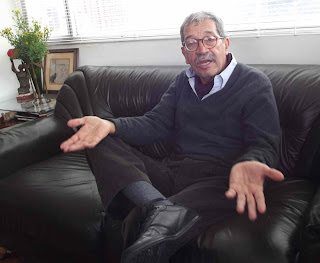
Gonzalo Medina displays a poster about La Ciclovia. 
In 1982, Gonzalo Medina visited Rio de Janeiro and was struck by how the city shut a shoreline avenue to car traffic each Sunday for pedestrians and bicyclists.
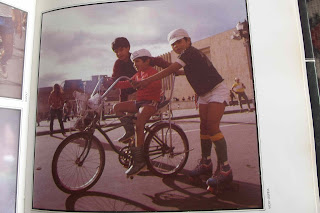
When Medina, then an official with Bogotá's transit department, returned home, he convinced city officials to try the same experiment on the Circunvular, the avenue running along the city's Eastern Hills. But after police complained that the closed road blocked access to a hospital, the new experiment called La Ciclovia was shifted to Ave. Septima.

One of Medina's goals even back then was to change the bicycle's image.

"Riding a bike was not only in bad taste," he said, but cyclists were seen "as people who couldn't afford a Renault."

La Ciclovia way back when. 
Over the following years, La Ciclovia won supporters and confronted opponents, Medina says, including some who wanted to restrict or even eliminate the institution in order to open roads for cars. La Ciclovia overcame its most recent threat several years ago, when a senator introduced a law closing La Ciclovia two hours earlier. The proposal met widespread opposition, including from cyclists and the city's sitting and previous mayors, and the proposal died. Over the years, La Ciclovia has also lost some segments, usually to make way for infrastructure projects.

A scene on La Ciclovía today. 
The Ciclovía concept wasn't born with Medina's trip to Rio. In the early- and mid-1970s a student initiative called the 'mitin de la bicicleta' created a Ciclovia on Avenidas Septima and 13. The idea was formalized by a 1976 decree, but it's not clear to me whether or not it lasted.


Participants in a mass aerobics class, called La Recrovia. 
Since its beginnings La Ciclovia has extended to hundreds of kilometers, added cycling courses and mass aerobics practices called La Recrovia.

The idea has also expanded across Latin America and into the United States, altho Colombia's version is still the largest and most frequent. There's even an International Network of Ciclovias organization to promote the concept. La Ciclovia, along with the TransMilenio express bus network and the city's bike lane network, once gave Bogotá a reputation for progressiveness and urban ingenuity, altho that image has since faded.

Medina says the biggest improvement to La Ciclovia over the years was Mayor Enrique Peñalosa's addition of the annual Ciclovia Nocturna, or night-time Ciclovia.
But the Ciclovia Nocturna happens only once a year, and part of its route is so packed with pedestrians that you can't ride a bike.

More important, it seems to me, is the way that La Ciclovia's become an essential Bogotá institution.

Various studies have found that the Ciclovia concept benefits not only participants' health, but also the economy, by saving on medical expenses.

"I'm proud," Medina says of his work. "It was an important contribution."

In Havana, Cuba, where Medina's wife works for the Colombian embassy, and where he says biking is risky, he continues pushing for better cycling conditions.

But to get more people onto bicycles, Medina believes that bikes mustn't be seen any longer as the 'poor man's vehicle.' In Bogotá, most bicycle commuters are still low income people who ride bikes to save on bus fare. In Colombia's class-conscious culture, the middle class and wealthy want to be seen in cars - even if that means spending hours trapped in traffic jams.

"There should be executives on bikes, so that the bike has status," Medina says.

Medina also advocates more space for pedestrians and cyclists, including car-free streets in the historical center.

Those measures would help Bogotá fulfill more of La Ciclovia's potential - to get Bogotanos to use their bikes not only on Sundays, but every day.

See some videos of Mr. Medina commenting, in Spanish, here, here, here and here.


By Mike Ceaser, of Bogotá Bike Tours

martes, 7 de agosto de 2012

The Return of the 26th Street Ciclovia

Cyclists on the just-reopened 26th St. Ciclovia. Behind them is a TransMilenio bus. 
The 26th St. corridor, historically one of the most important sections of Bogotá's famed Ciclovia, reopened today after being closed for years because of TransMilenio expansion work which is years behind schedule.


Beyond the return of this major Ciclovia section, the restoration of the 10-kilometer 26th St. route also signals the city's commitment to at least some aspects of cycling. It also bodes positively for the survival of the 7th Ave. Ciclovia, its most important section - whenever the city finally builds efficient public transit there.

Transit officials have worried that the TransMilenio buses could endanger nearby cyclists by the air turbulence they generate. But, apparently officialdom has reconsidered the risk and decided that cyclists and TransMilenio can coexist. Nevertheless, any danger could be more of a factor on Seventh Ave., since it's much narrower. (The city's latest plan is to build light rail on Seventh, but nothing's certain.)


A meter-wide barrier is intended to prevent cyclists from nearing the TransMilenio buses.
On the other hand, the 26th St. Cicloruta, or bike lane, which was built into the new TransMilenio line, has received lots of criticism. Check out this humorous video, which highlights the lane's few of entry and exit points.


Also, on its eastern end, the bike lane separates from 26th St. and follows its old route, passing thru the grimy Santa Fe neighborhood and the red light district to connect to Seventh Ave. Unfortunately, fear of crime will discourage some cyclists from using this route. It's also made difficult by neglect and the general sad state of the Cicloruta. Take, for example, this homeless scavenger who blocks the Cicloruta with his cart most every day. Police, obviously, give protecting Ciclorutas little importance.

A bike lane blocked by a scavenger's cart in the Santa Fe neighborhood. If he was blocking cars, you can bet there'd be protests. 
By Mike Ceaser, of Bogotá Bike Tours

martes, 27 de diciembre de 2011

La Ciclovia is Good Business!

Ciclovia-type events' economic benefits far outweigh their costs. 
Bogotá's fun, healthful Ciclovia is sometimes described as 'the world's longest street party.'

But it also gets criticized as a frivolous luxury which should be restricted to reduce inconveniences for cars. A few years ago, a congressman tried and failed to cut back La Ciclovia's ending time to noon from 2 p.m. for just that reason.

Kids ride new bikes on Bogotá's Ciclovia. 
After all, everybody knows that automobile drivers are doing something important, while joggers, skaters and bicyclists are wasting time which could be better spent burning fossil fuels.

But now a study published in the Journal of Urban Health finds that Ciclovias, which were pioneered by Bogotá, are good for the economy, too.

The researchers looked at four Ciclovia-type events: in Bogotá and Medellin; Guadalajara, Mexico and San Francisco, California.

The researchers tried to evaluate to what extent the Ciclovía events increased participants' physical activity and also calculated the events' costs. Bogotá's Ciclovia came out first on all points. Firstly, it's the cheapest per-capita of all of the events, at only U.S. $6.00 per participant per year, compared to $6.5 for Guadalajara, $23.4 for Medellin and $70.5 for San Francisco. That's likely because of the Bogotá Ciclovia's great number of participants and greater frequency than the events in other cities. What's more, the Bogotá Ciclovia also produced more savings per peso or dollar invested than the other Ciclovias, all of which were 'profitable,' according to the study. Bogotá's Ciclovía returned between $3.23 and $4.26 for each dollar invested, Medellin's $1.83, Guadalajara's $1.02 to $1.23 and  San Francisco's $2.32.

Doing aerobics in the Recrovia, part of the Ciclovia. 
The 'profits' include only saved medical costs, and not the healthier people's greater productivity at work, which must be substantial.

The return on investment is lots bigger than that produced by a gymnasium or a swimming pool because the infrastructure - roads and parks - is already built.

Of course, La Ciclovía's real value is in the improved quality of life it produces. But cold economic numbers like these justify La Ciclovia for businessmen who are addicted to their cars, or even sell cars.

Comparative weekly costs of various physical activity programs. Bogotá's Ciclovia is the furthest left.
(Graph: BikePortland.org)
Thanks to this 'silly and inconvenient' Ciclovia event, their employees are happier, more productive, miss fewer days of work and have lower health care costs.

Now, if only Bogotá would improve cycling conditions during the other six days of the week!

See also: Study: Health benefits outweigh costs of ciclovia events

By Mike Ceaser of Bogotá Bike Tours

viernes, 18 de marzo de 2011

Updates

Councilman Ferreira, his assistant Sandra, and Andrés Felipe debate. 
A hearing not about La Ciclovia.
This Wednesday, City Councilman Carlos Orlando Ferreira had scheduled a public hearing on the future of La Ciclovia de la Septima. (The councilman apparently did not know that city officials had promised the cycling community that the Ciclovia would not fall victim to planned Transmilenio construction on Seventh Ave.)

As it turned out, I heard only one speaker even mention La Ciclovia, altho it did become very clear that nobody plans a bike lane for Seventh Ave. Almost all the speakers at the hearing talked only about whether or not a Transmilenio line should be built on La Septima, and if so, whether full-scale TM or Mayor Moreno's 'TM light idea.'

But I did talk to folks about bicycling issues, and got updates on several cycling subjects:

- Ferreira's much-ballyhooed public bikes program apparently has not advanced - but he says he hasn't abandoned it, either. Ferreira now plans to launch a pilot project in June. But he had no more details, such as in which neighborhood it would function, or how many bikes it would involve. Which suggests to me that it won't happen. And, as I've written before, to make public bikes succesful, Bogotá needs to solve problems such as the chaotic traffic and pollution so that people are willing to get on bicycles.
A Bogotá Cicloruta, near downtown.
- Mayor Moreno's promise to build 20 kilometers of new Ciclorutas hasn't happened. Andrés Felipe Vergara, a member of the city's Bicyclists' Consultant Group (Mesa de la Bicicleta) and leader of the Wednesday night bike rides, said the city recently built about a kilometer of new bike lane in north Bogotá, around 125th St. - but that this Cicloruta is poorly designed and impractical to use.

Andrés sketches a disjointed Cicloruta.
- Andrés also pointed out a fundamental problem with the city's Ciclorutas - they were built and are (supposed to be) maintained by about four different public agencies - the city's Transit agency, the Urban Development Institute (IDU), the water district, and maybe even more. Each agency has built some stretches of Ciclorutas, but there's little coordination between them, so the network is disjointed and unconnected. Also, many are poorly maintained, and with such a variety of agencies, it's hard pinning responsibilities.

- Andrés also gave me a sad news item. The Mesa de la Bicicleta, a sort of citizens' consultancy group on cycling issues, has ceased to meet. Andrés said this is because nobody listened to their proposals. The Moreno administration has never seemed interested in cycling issues.

The Las Aguas bicycle parking facility. 

- Finally, the bicycle parking building at the Las Aguas TM station is operating, and is being used, altho demand has not been overwhelming. Today, I counted about a dozen bikes hanging inside (it has some 140 spaces) - which at least means a dozen cyclists' lives facilitated - and perhaps a few more bikes on the road. The facility opened after sitting empty for years, and only after cyclists held a mock funeral in protest.

By Mike Ceaser, of Bogotá Bike Tours