Mostrando entradas con la etiqueta medellin. Mostrar todas las entradas

martes, 27 de diciembre de 2011

Medellin's Public Bicycles Roll Forward

EnCicla riders ready to roll. (Photo: Medellin Transit Dep't)
While Bogotá's 'public bicycles' gather dust somewhere, Medellin is expanding its own system.

Bogotá would appear to lend itself more to public bicycles: it's a big, flat, dense city with a reputation as a cycling pioneer - and lots of traffic jams. But Medellin has been rolling forward with its program, called EnCicla, while Bogotá's is parked.

Jesus David Acero, the program's administrator and an official with Medellin's transit office, said Medellin's program has succeeded thanks to careful groundwork and planning -and most of all support from municipal and regional officials.

Medellin had cycling experts design its system, Acero said, and used specially-designed bicycles, together with software to manage the system.

Medellin's pre-designed bicycles.
(Photo: Medellin Transit Dep't)
In contrast, Acero says, Bogotá employed ordinary bicycles and neither carefully planned its pilot public bicycles project, nor has produced a thorough analysis of its results.

Still, Bogotá's public bike test program, called BiciBog, was quite well received and got good use - at least in its north Bogotá station. The south Bogotá trial received less demand, perhaps because many of the residents in the lower-income area have their own bicycles, as well as because of competition there from bicitaxis.

But Bogotá officials haven't indicated when or whether they'll continue the system. Acero says, however, that officials from the administration of incoming leftist Bogotá mayor Gustavo Petro have indicated interest in creating a public bike program here.

Meanwhile, Medellin's public bike program is still technically in its pilot stage, but has been extended until March of 2012 and expanded from being available to only the students of two universities to the public in general. Not one of the bikes, which are equipped with GPS trackers, has been stolen.

Currently, the program has 145 bicycles, 105 of which are in the city and 40 in a rural park area and 11 parking stations. Users pay nothing and get to use the bikes for one hour at a time. Those who go over the limit lose borrowing privileges for three days.

Bogotá's public bicycles in action. They weren't designed for shared use, however. And they're now collecting dust. (Despacio.org)
How much more the program can expand, Acero says, will depend on how much support they get from politicians and businesses. During 2011, the city funded the program with one (American) billion pesos, but Acer's hoping to get five times that much for 2012. Users have indicated a willingness to pay for the service, but only about 1,000 pesos per ride, so the program is seeking business sponsors.

The Medellin government "will have a hard time not expanding the public bikes program," Acero says, "because it's been very well accepted."

But Acero expresses lots of frustration about Bogotá's lack of progress. In fact, at this writing the folks in charge of BiciBog have yet to deliver their final report, which has been postponed at least once.

EnCicla's Facebook Page.

By Mike Ceaser, of Bogotá Bike Tours

lunes, 14 de noviembre de 2011

And Victory Goes to the Fittest

There they go! A cyclist races a TransMilenio bus in Bogotá.
The University of the Andes sponsored the second-annual 'Transit Modalities Race' Friday, and once again the winner is: The bicycle!

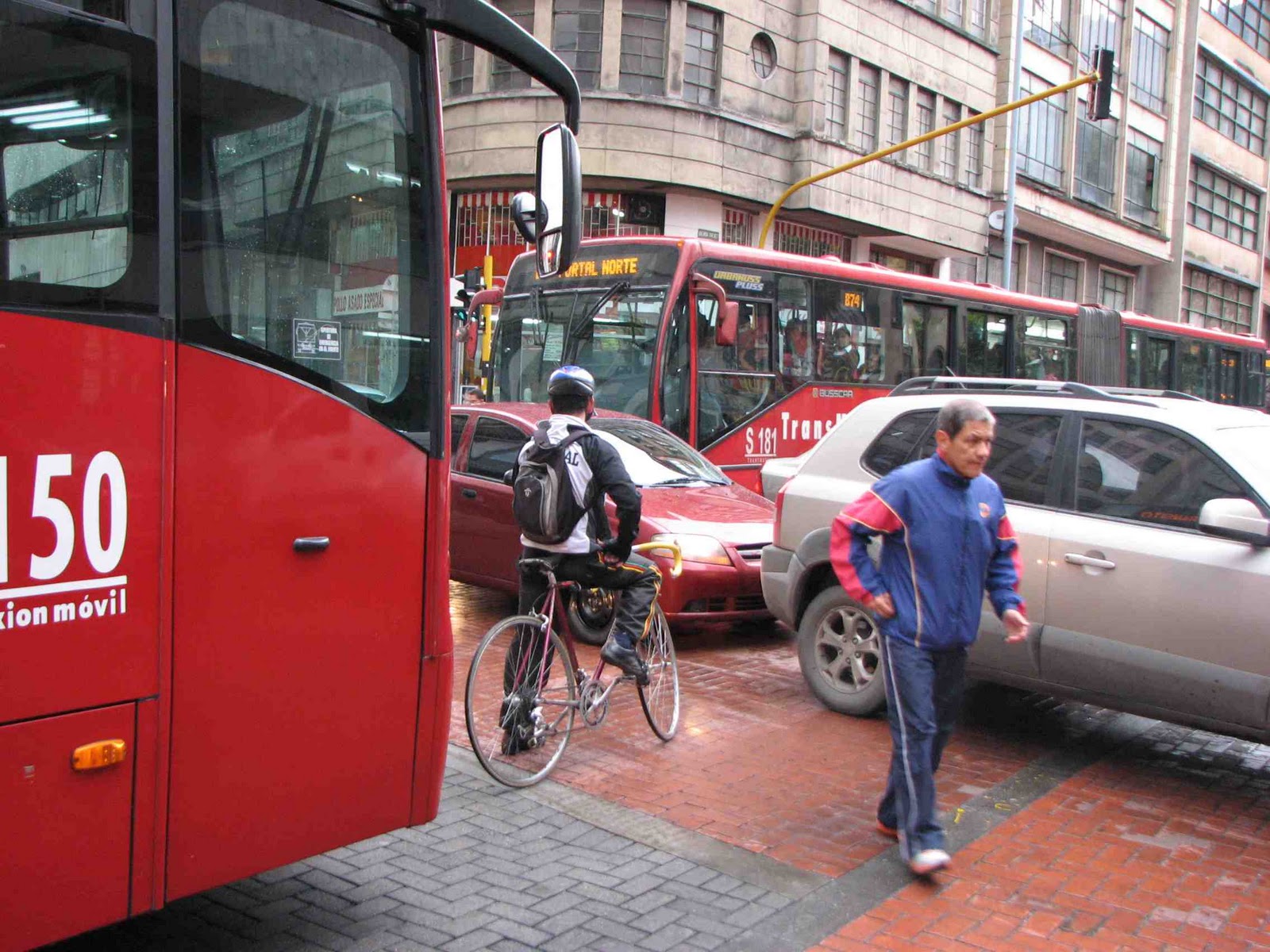
On Jimenez Ave., private cars block each other,
TM buses and even a cyclist. 
The race consisted of 12 commuters, three each in private cars, TransMilenio buses, regular buses and on bicycles, who left at 8 a.m. from three different spots around Bogotá and commuted to the Andes University, in La Candelaria.

The cyclists won far and away, averaging 21.5 kilometers per hour - leaving them time for a coffee and a long shower before the private cars arrived, having averaged only 15.5 KPH, barely ahead of the TransMilenio at 15.3 KPH. The regular bus averaged only 13.4 KPH. The cyclists in fact won all three races.

I was surprised, however, that the private car drivers beat the TM buses - albeit only by a hair. But the TM's time was really hurt by a last-place showing in one of the routes, from north Bogota, where it lost even to the regular bus. So I wonder whether that TM route experienced some extraordinary delay, such as an accident or a completely perverse traffic jam - most likely caused by private cars.

No way to travel: cars wait and wait in central Bogota. 
A Bogotá Cicloruta. 

On the other hand, the fact that the private cars were slower on all three routes than bicycles, and in one also lost to both the TM and the regular bus, underlines the insanity of investing millions of pesos in big, polluting machines which clog the roads and often carry only one or two people.

The bicycles' victory is particularly meaningful right now because both Bogotá and Medellin are carrying out pilot public bicycle projects. The news reports I've seen about the Medellin program have been positive, while those about Bogotá's, named BiciBog, have been mixed. Some transit experts opine that Bogotá's public bikes aren't comfortably designed or very durable and are too big for many Bogotanos, and that the stations aren't well located. Observers are also asking about where some of planning money went. (See, for example, Carlos Pardo's blog, where he also asks why the bikes are only for people over age 16, and why the instructions appear to restrict use to Ciclorutas - which would eliminate many destinations.)

BiciBog bikes. (Photo: El Espectador)
Planners have responded that these bikes are only for testing purposes, and that when the real system starts, it'll use especially-designed bikes. And that the same goes for the system of bicycle stations.

Yet, despite all of this, the bikes, which are free, appear to be receiving lots of use. This is encouraging. But creating a city-wide system will mean dealing with lots of problems, including crime and mechanical difficulties, Bogotá's helmet law and pollution and chaotic traffic, which make cycling unpleasant and even dangerous for your health.

By Mike Ceaser, of Bogota Bike Tours

domingo, 17 de julio de 2011

Public Bicycles for Medellin

Simple and sturdy: Will Medellin's public bikes look like this one? (Photo: Facebook)

The city of Medellin plans to start up a public bicycles program this September, which would make it the first city in Colombia with such a system.

Better and faster on a bike? A traffic jam in Medellin.
(Photo: www.ecbloguer.com)
The program is to begin this September with 160 bicycles and continue at least until December, when it will be evaluated. The bicycles are being made by a local company, Bici-K, and will carry GPS trackers. The program is to operate 15 hours every day. The scheme will also include 45 bicycles in the Arví Natural Reserve, according to El Tiempo, altho it's not clear whether those are in addition to the 160 bikes. The city also plans to hire between 20 and 30 university students to administer the system.

Medellin has mild, warm weather conducive to cycling. But it rains a lot and the city is hilly. Hopefully, the system will succeed and serve to pressure Bogotá to create its own public bikes system.

According to my reading, Medellin will be the fourth city in South America and the fifth in Latin America with a public bicycles program, after Santiago, Chile; Rio de Janeiro, Brazil; Buenos Aires, Argentina and Mexico City. The only such experiment I've heard of in Colombia were the public bikes on the campus of Bogotá's National University. That program was ended because many bicycles were stolen and damaged - despite the fact that the university is surrounded by a fence with security. However, the university had no system to track who was using the bicycles.
A prototype of the public bikes planned for Medelling, according to El Mundo newspaper.
A Bogotá city councilman announced plans years ago to create a public bikes program in Bogotá. But it hasn't moved forward, and I doubt its prospects until Bogotá improves cycling conditions by controlling pollution and taming the chaotic traffic.

By Mike Ceaser, of Bogotá Bike Tours