viernes, 1 de abril de 2011

Kaos in Bogotá!

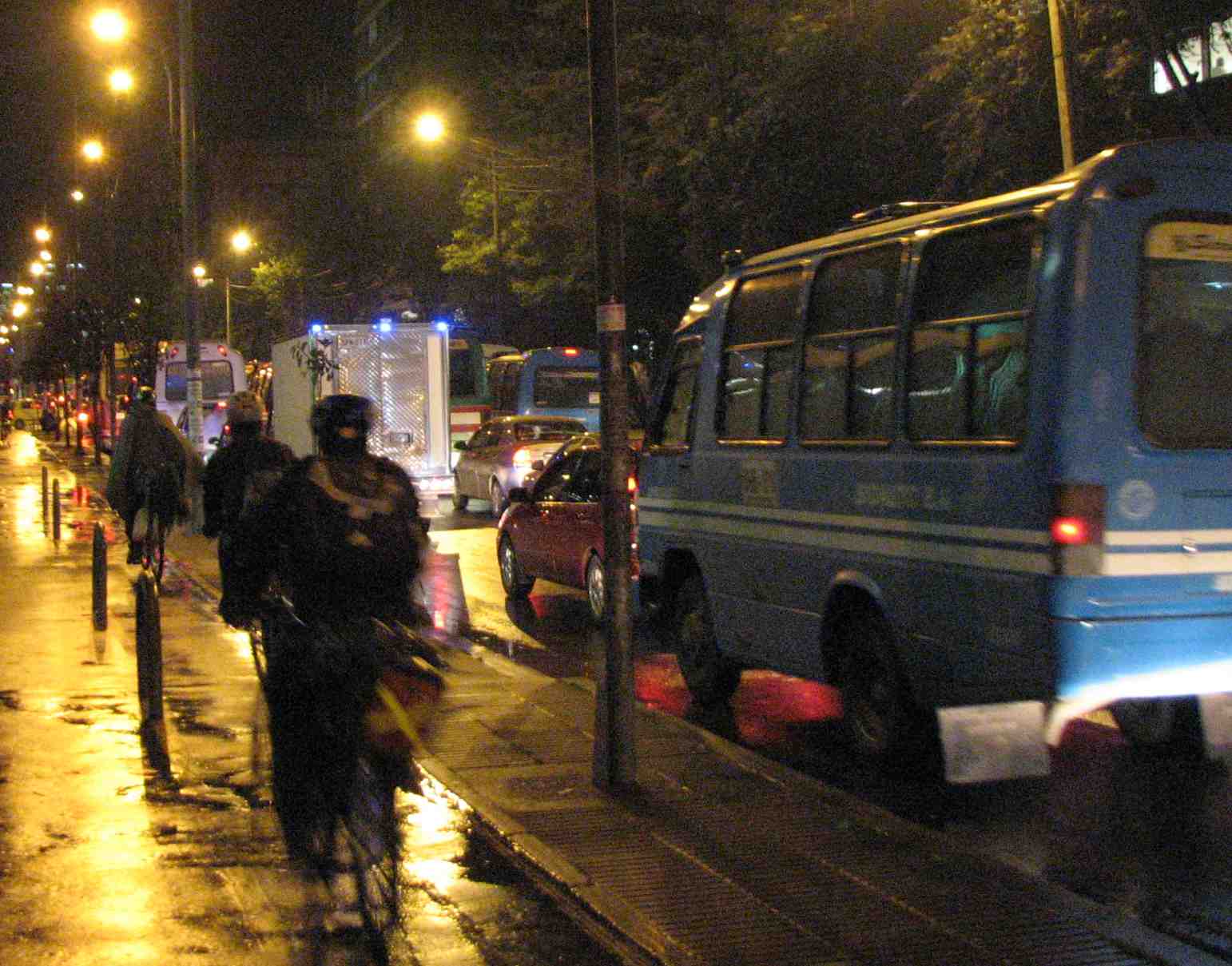
And I'm not referring to this city's crazy traffic.


A group from Kaos Pilot, a Danish school which does hands-on classes about entrepeneurship and social development, is in Bogotá working on a variety of projects, including two to promote bicycling: they are helping a schoolteacher who is arranging a educational bicycling outings for students and also supporting the civil society organization Mejor en Bici. Mejor en Bici works to promote the daily use of bicycles for commuting and other purposes.

According to anecdotal observations, the number of Bogotá cyclists has increased recently, at least among the upper-income, folding bike crowd. Anyway, that's what David Serna, a student at Jorge Tadeo University and author of the colorful Cycle Chic Bogotá blog. But many of us suspect that the amongst the booming number of loud, obnoxious, dangerous and polluting motorcyclists on Bogotá's streets are many ex-cyclists, who 'moved up' to a more powerful vehicle.

Ex-Cyclists? Chaos on Bogotá's streets. 
By Mike Ceaser, of Bogotá Bike Tours


viernes, 18 de marzo de 2011

A U.S. Expert's View

Try biking this Cicloruta - we did!
A woman who works for a major United States city's bicycle lane program rode some of Bogotá's own Ciclorutas the other day with Bogotá Bike Tours - and she didn't give them a rave review.

(The woman, who works for a city which is expanding its own cycle route system, wanted to remain anonymous so as not to seem to be giving official views.)
A bike lane in a North American city.
We rode, or tried to, down the Cicloruta along the south side of 13th St., near downtown. But the Cicloruta was so mobbed by pedestrians that pedaling was nearly impossible. In her city, she said, the bike lanes are built on the streets, either inside or outside the line of parked automobiles. This means less conflict with pedestrians, but potentially more with car drivers.

Some parents, who worry about their children riding near traffic, might be more inclined to let their kids pedal down Bogotá-style sidewalk bike lanes, she suggested.

And, of course, traffic in Bogotá isn't traffic in the United States, where driving and pollution laws are enforced. In Bogotá, cars would undoubtedly invade bike lanes not protected by physical barriers. And, riding on the sidewalk, one is at least a bit distanced from Bogotá's highly-polluting vehicles, which are not burdened by catalytic converters.

Hazardous arcs?
The U.S. expert also observed that Bogotá's bike lanes are narrower than those in her city, and that those metal posts and arcs meant to divide Bogotá's Ciclorutas' lanes and to block cars from entering them pose a collision hazard themselves. "I don't think they'd meet our safety standards," she said. In her city, similar posts are made of flexible plastic.

In her city, too, the city has painted arrows and symbols on the streets directing cyclists to designated bike lanes.

The expert suggested that Bogotá cycling is faced with a sort of Catch 22: Too few cyclists ride Bogotá's streets (except perhaps during rush hour) to make people conscious of the bike lanes, or to make others feel like they'd be safe on their bikes.

So, Bogotá needs more cyclists out there in order to get more people bicycling!

What could start this positive cycle? She says Bogotá needs more cycling advocacy and suggests improving bicycling conditions, such as reducing pollution, as well as a government publicity campaign advocating cycling. It would be, certainly, much cheaper than the alternative - building more roads. 

By Mike Ceaser, of Bogotá Bike Tours 

Updates

Councilman Ferreira, his assistant Sandra, and Andrés Felipe debate. 
A hearing not about La Ciclovia.
This Wednesday, City Councilman Carlos Orlando Ferreira had scheduled a public hearing on the future of La Ciclovia de la Septima. (The councilman apparently did not know that city officials had promised the cycling community that the Ciclovia would not fall victim to planned Transmilenio construction on Seventh Ave.)

As it turned out, I heard only one speaker even mention La Ciclovia, altho it did become very clear that nobody plans a bike lane for Seventh Ave. Almost all the speakers at the hearing talked only about whether or not a Transmilenio line should be built on La Septima, and if so, whether full-scale TM or Mayor Moreno's 'TM light idea.'

But I did talk to folks about bicycling issues, and got updates on several cycling subjects:

- Ferreira's much-ballyhooed public bikes program apparently has not advanced - but he says he hasn't abandoned it, either. Ferreira now plans to launch a pilot project in June. But he had no more details, such as in which neighborhood it would function, or how many bikes it would involve. Which suggests to me that it won't happen. And, as I've written before, to make public bikes succesful, Bogotá needs to solve problems such as the chaotic traffic and pollution so that people are willing to get on bicycles.
A Bogotá Cicloruta, near downtown.
- Mayor Moreno's promise to build 20 kilometers of new Ciclorutas hasn't happened. Andrés Felipe Vergara, a member of the city's Bicyclists' Consultant Group (Mesa de la Bicicleta) and leader of the Wednesday night bike rides, said the city recently built about a kilometer of new bike lane in north Bogotá, around 125th St. - but that this Cicloruta is poorly designed and impractical to use.

Andrés sketches a disjointed Cicloruta.
- Andrés also pointed out a fundamental problem with the city's Ciclorutas - they were built and are (supposed to be) maintained by about four different public agencies - the city's Transit agency, the Urban Development Institute (IDU), the water district, and maybe even more. Each agency has built some stretches of Ciclorutas, but there's little coordination between them, so the network is disjointed and unconnected. Also, many are poorly maintained, and with such a variety of agencies, it's hard pinning responsibilities.

- Andrés also gave me a sad news item. The Mesa de la Bicicleta, a sort of citizens' consultancy group on cycling issues, has ceased to meet. Andrés said this is because nobody listened to their proposals. The Moreno administration has never seemed interested in cycling issues.

The Las Aguas bicycle parking facility. 

- Finally, the bicycle parking building at the Las Aguas TM station is operating, and is being used, altho demand has not been overwhelming. Today, I counted about a dozen bikes hanging inside (it has some 140 spaces) - which at least means a dozen cyclists' lives facilitated - and perhaps a few more bikes on the road. The facility opened after sitting empty for years, and only after cyclists held a mock funeral in protest.

By Mike Ceaser, of Bogotá Bike Tours

jueves, 17 de febrero de 2011

Hit and Run on the 13th

Broken bike
Enrique was cycling along the Carrera 13 cicloruta this afternoon a bit after 5 p.m., assuming that on the cicloruta bicycles had some sort of priority - or at least some respect.

Enrique's scraped arm
That changed when a car pulling out across the sidewalk hit his rear wheel, causing him to run into a pole and fall off the bike. The bike's fork was bent backwards, the derailleurs twisted and the chainring bent. Enrique was scraped and bruised but otherwise alright.

By the time Enrique picked himself and looked around, the driver who'd hit him had left the scene - undoubtedly angry at the impudent cyclist who'd had the nerve to get in front of his vehicle. It's a wonder, incidentally, that the driver was able to leave the scene at all, amidst the avenue's rush hour traffic congestion.
The scene later on on La 13 - nothing moving but the bikes. 
By Mike Ceaser of Bogotá Bike Tours 

domingo, 13 de febrero de 2011

Bicycle Theft on La Ciclovía - Redux!

Why would a thief carry off a bike instead of riding it? Why would a bike thief wear a mask? But the photo's dramatic!

It's a real problem. Today, one of Bogotá Bike Tours' bikes got stolen, from a client. She had gotten off of the bike on Seventh Ave. and 64th St., during La Ciclovia, when some guys dressed in cycling clothing approached her and invited her on rides up a road outside of Bogotá. Suddenly, one of them pulled out a knife, another hopped on the bicycle, and that was it.

I'll point out that this wasn't just any old bike, but a shiny new aluminum frame bike. The best way to not have this happen to you is to ride an old, or old-looking bike.

It's happened many times before, to us and to others. Few items are easier to make off with than a bicycle, or easier to sell. I suspect that they'll repaint ours or send it to Medellin or elsewhere to fence. And, the best place to steal a bike is on La Ciclovia, where all you have to do is sit back and wait until a vulnerable-looking person passes by on a nice bike.

Obviously, in a city of eight million people, the police can't be everywhere. And, in any case, every time I visit a police station to place a denuncia - which I've done more than once - the cops complain that their hands are tied by Colombian law, and that using 'bait bikes' would mean illegal entrapment.

These thieves are not kids who spot an opportunity, but organized rings which prey regularly on cyclists. So, catching them would mean recovering lots of bikes and preventing many future thefts. 

Anti-theft advice consists mostly of locking your bike securely, with one or even two U-locks.

But this advice isn't worth much against Bogotá thieves, who aren't shy about taking the bike from its rider - whether by deceit, threat or physical strength.

On La Ciclovia: Your bike could be next!
In a previous incident, the thieves also worked in a team. One blocked the cyclist's path along La Ciclovía, forcing him to stop. Then his buddy pulled the rider off of the bike and hopped on himself. In a moment, they were gone. I've heard of other cases in which the thieves simply befriend the victim and then ask to try out their bike. You can image what happens next.

The one thing which can stop these thefts is public action. If the many people nearby would only respond by yelling at the thieves, grabbing the stolen bike's rear wheel, blocking the thief's path - any of many things which meant almost no risk to themselves - the thief might very well have gotten caught, and might even seek a different line of work.

My advice: Carry a lock, be aware of who's around you. And, most of all, don't be vain. Ride an older bike or make your new bike look older and worn! 

By Mike Ceaser, of Bogotá Bike Tours

viernes, 4 de febrero de 2011

Bogotá's Car-Free Day

University of the Andes students pedaling home. But how many of these generally wealthy kids will leave the car at home and make bicycling a habit?
Car-Free Day 2011, on Thursday Feb. 3, brought out more cyclists, but not the crowds of pedalers I'd hoped for. More importantly - do Car-Free Days create any lasting changes?

Certainly, the streets were less congested and bicycling more bearable. Here are some cyclists passing our clean-air protest on Seventh Ave., enjoying more than the usual road space, and slightly cleaner-than-normal air. El Tiempo reported that the number of cyclists increased 46 percent on Car-Free Day.


A few of us from Bogotá Bike Tours protested the city's horrendous and clearly uncontrolled pollution. I felt a lot like Don Quijote charging windmills as we hung out our banners and talked about air pollution to pedestrians who mostly walked past uninterested, often smoking.

I reflected on how many bogotanos were likely complaining right then that their favorite TV show was canceled, that there are no grapes in the market, that the car is dirty, that the maid is late, that the ice cream is frozen too hard...and only four of us out of those nine million bogotanos were out protesting something which must sicken and kill thousands of people every year.

During our protest, a sampling of Bogotá's bicyclists passed by, including several fixie riders on their super-light machines, a Spanish woman who told us about the Bicing public bikes in Barcelona and, most memorably, Green Man with his lighted-up bike, who carries on a constant and very quixotic campaign for environmental sanity.

This guy felt the need to wear a facemask even on Car-Free Day, rebaptized Clean Air Day.

I doubt the day will spur any lasting changes in bogotanos'  behavior, or respect for cyclists and other non-motorized travelers. The day after, pollution was back out in force, and cars once again blocked pedestrian and cyclsts-access, because nobody counts in this town unless they're motorized!


Here's our bike tour cruising through the normally car-choked Santa Fe neighborhood.
And here's that same stretch of street the next day. See the smog-belching truck? 
We ended the day in the National Park with a protest against pollution. Both Parchita and Green Man, as well as some guys on fixie bikes, turned out in support. 
By Mike Ceaser, of Bogotá Bike Tours

jueves, 13 de enero de 2011

Colombia's Great Bike Racing Tradition


Thanks to its Spanish inheritance and many mountains, Colombia may have produced more great bicycle racers per capita than any other nation outside of Europe. Until Jan. 31, the Archivo de Bogotá has an exhibition about Colombian bicycle racing, its heroes and the epic Vuelta a Colombia. In Colombia, bike racing really rates, and may be the second most popular pro sport after futbol (soccer).

The Vuelta a Colombia is shorter than the Tour de France, but its passes are higher, making it one of the most demanding bicycle stage races in the world.
Vuelta Champs of Yesteryear
Perhaps thanks to Colombia's many mountains, the country has produced many great climbers. In fact, since 1985 four of the Tour de France's King of the Mountains title holders have been Colombian, the last two being Santiago Botero and Mauricio Soler.
Santiago Botero overlooking a classic bicycle
Probably my favorite aspect of the exhibition was the look at a time when the races seemed more epic, the sport more innocent and every victory wasn't tainted by doping accusations. And remember those sleak, elegant bikes with Campagnolo components, made by Italian craftsmen steeped in cycling tradition, rather than some factory in East Asia, where the workers couldn't care less whether they were making parts for boats, planes or bicycles.
Ramón Hoyos Vallejo, winner of the third Vuelta, got the girl. 

Slogging up a hill in the 1961 Vuelta.
 

 Juan Pachon and Miguel Samaca, riders from other eras, now compete in sales on Carrera 13.

By Mike Ceaser, of Bogotá Bike Tours