lunes, 14 de noviembre de 2011

And Victory Goes to the Fittest

There they go! A cyclist races a TransMilenio bus in Bogotá.
The University of the Andes sponsored the second-annual 'Transit Modalities Race' Friday, and once again the winner is: The bicycle!

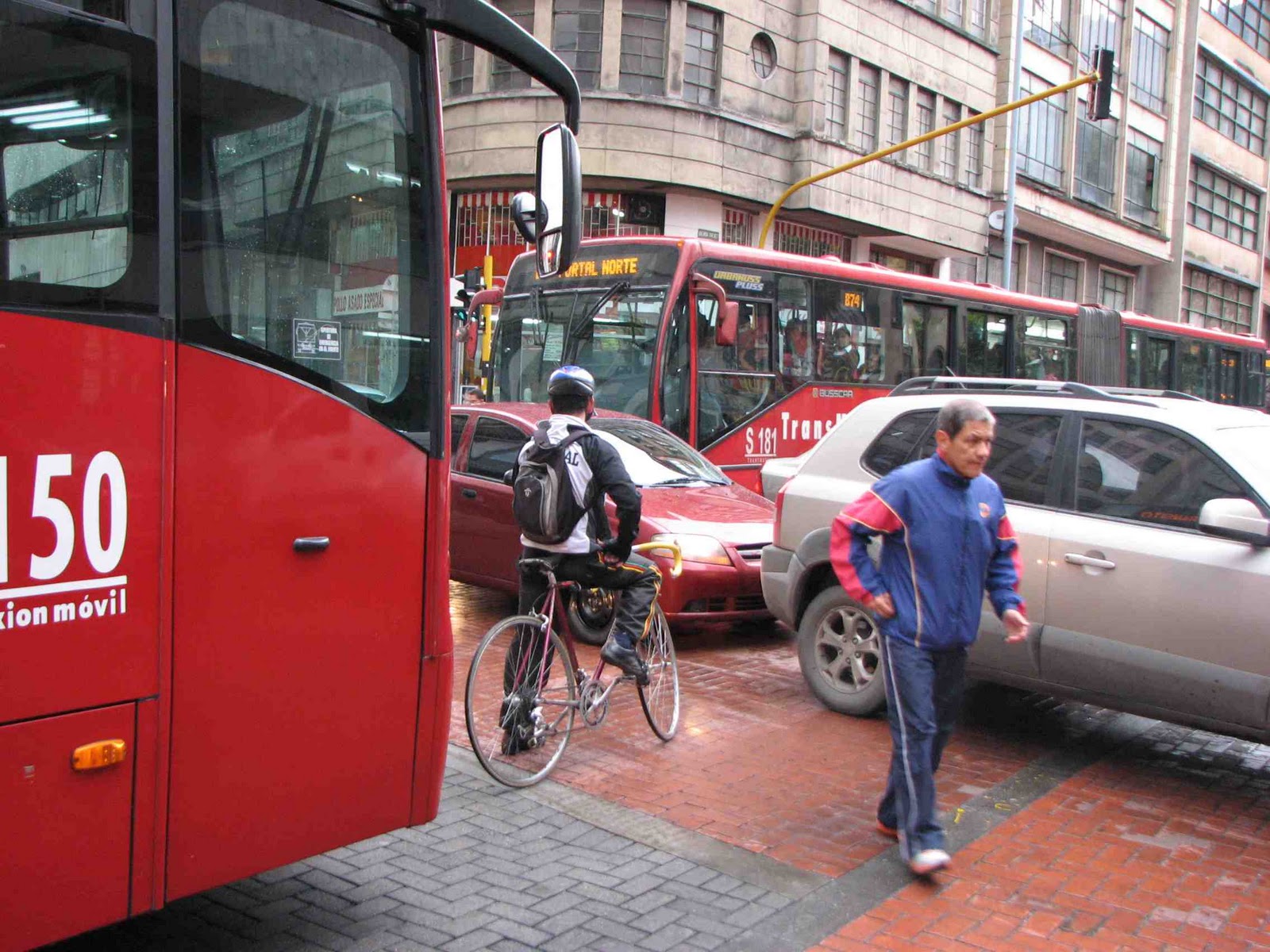
On Jimenez Ave., private cars block each other,
TM buses and even a cyclist. 
The race consisted of 12 commuters, three each in private cars, TransMilenio buses, regular buses and on bicycles, who left at 8 a.m. from three different spots around Bogotá and commuted to the Andes University, in La Candelaria.

The cyclists won far and away, averaging 21.5 kilometers per hour - leaving them time for a coffee and a long shower before the private cars arrived, having averaged only 15.5 KPH, barely ahead of the TransMilenio at 15.3 KPH. The regular bus averaged only 13.4 KPH. The cyclists in fact won all three races.

I was surprised, however, that the private car drivers beat the TM buses - albeit only by a hair. But the TM's time was really hurt by a last-place showing in one of the routes, from north Bogota, where it lost even to the regular bus. So I wonder whether that TM route experienced some extraordinary delay, such as an accident or a completely perverse traffic jam - most likely caused by private cars.

No way to travel: cars wait and wait in central Bogota. 
A Bogotá Cicloruta. 

On the other hand, the fact that the private cars were slower on all three routes than bicycles, and in one also lost to both the TM and the regular bus, underlines the insanity of investing millions of pesos in big, polluting machines which clog the roads and often carry only one or two people.

The bicycles' victory is particularly meaningful right now because both Bogotá and Medellin are carrying out pilot public bicycle projects. The news reports I've seen about the Medellin program have been positive, while those about Bogotá's, named BiciBog, have been mixed. Some transit experts opine that Bogotá's public bikes aren't comfortably designed or very durable and are too big for many Bogotanos, and that the stations aren't well located. Observers are also asking about where some of planning money went. (See, for example, Carlos Pardo's blog, where he also asks why the bikes are only for people over age 16, and why the instructions appear to restrict use to Ciclorutas - which would eliminate many destinations.)

BiciBog bikes. (Photo: El Espectador)
Planners have responded that these bikes are only for testing purposes, and that when the real system starts, it'll use especially-designed bikes. And that the same goes for the system of bicycle stations.

Yet, despite all of this, the bikes, which are free, appear to be receiving lots of use. This is encouraging. But creating a city-wide system will mean dealing with lots of problems, including crime and mechanical difficulties, Bogotá's helmet law and pollution and chaotic traffic, which make cycling unpleasant and even dangerous for your health.

By Mike Ceaser, of Bogota Bike Tours

domingo, 6 de noviembre de 2011

Is Biking in Bogotá Bad for You?

Don't breathe deep: Cyclists on car-clogged Carrera 10.
Smokin' - a belching Bogotá bus. 
I've seen a spate of articles recently celebrating the benefits of bicycling. For example, there's 'Secret to a long, healthy life: Bike to the store' on the U.S.'s National Public Radio, or this one about a study finding that replacing driving with cycling would save billions of dollars in fuel and car expenses, slash health expenses and improve air quality.

But is it true here in Bogota?

Cyclists on a Cicloruta on Calle 13.
A recent study by professors at the National University found that cyclists who used Ciclorutas along busy avenues suffered significantly more respiratory problems than those who used Ciclorutas exposed to less pollution. The strange thing about the study is that this doesn't mean only that Cicloruta users are at risk, but that all users of these avenues are, including the people in vehicles trapped in traffic jams.

Of course, this doesn't change cycling's great benefits for the city, in less pollution, traffic congestion and fuel consumption. And bicycling still reduces obesity and improves health in many ways, despite the pollution.

But I was disappointed by some of the comments other readers had left on the story, which criticized the academics for doing the study and the media for disseminating it 'Because it would discourage people from bicycling.'

A delivery cyclist wears a protective face mask. 
That might be true. But, even if everybody stops cycling, the pollution will continue sickening Bogotanos in their homes, cars, buses and walking along streets. And, unless authorities take strong measures, it'll just get worse and worse and worse as more cars flood into the city, creating more congestion and the existing cars, buses and trucks age.

The solutions aren't complicated, altho they might be difficult to implement:

Newly-elected mayor needs to follow thru on his promise to create a London-style congestion charge for private vehicles. That would reduce congestion and pollution and provide more money for public transit.

A cyclist trapped by cars on Jimenez Ave. 
The city needs to go ahead with implementation of the Integrated System of Public Transit, the SITP, which would impose some order on the private buses and phase out thousands of the oldest, and presumably the dirtiest, buses.

But, first and foremost, city officials need to enforce the law. EcoPetrol has promised to clean up Bogotá's gasoline and diesel fuels to international standards and officials must hold the company to its word. And EcoPetrol can afford to provide clean fuel for Colombia's capital city - the company earned record profits last year. Even more fundamentally, the city needs to enforce air pollution laws on vehicles and factories. Observation of many of Bogotá's cars, trucks and buses, some of which apparently run on coal, makes it obvious that pollution laws are a dead letter.

'Location of Ciclorutas can be damaging to health' - U.N. News Agency

Check out this video, in Spanish, denouncing pollution in Bogotá. (Video sobre contaminacion en Bogotá.)

sábado, 5 de noviembre de 2011

Reinventing the bike

A bike converted to electricity by La Salle University students. 
La Salle University students have improved the bicycle! This group invented a system to modify a standard bike to battery power.

The battery wheel can be purchased by itself, altho it's not cheap: 800,000 pesos.

svargas55(at)unisalle(dot)edu(dot)co,
cttovar64(at)unisalle(dot)edu(dot)co 
These two students invented a detachable bicycle basket, which converts into a wheeled cart for heavy loads.

It detaches....
And rolls along! 

By Mike Ceaser of Bogota Bike Tours

viernes, 28 de octubre de 2011

November's La Bicicletada

Cyclists ready to go!
For the last two years, students from Bogotá's Universidad Central have been organizing these monthly bicicletadas around various parts of central Bogotá. Their purpose is to have fun, see the city and encourage bicycle use, especially bicycle commuting. The last-Friday-of-the-month rides are open to students from all universities. The organizers told me they've motivated at least a few students to dust off their two-wheelers and head to school on them. Still, only a few dozen Central University students bike to school.

Today's ride, on bikes from Bogotá Bike Tours, visited the National Museum, Independence Park and the National Library.


On a nice bike lane, or Cicloruta. 
Entering the National Museum

Outside the National Museum

In Independence Park. 

In Independence Park's information kiosk.


In front of the art-deco National Library of Colombia

Near the National Library.


A talk inside the National Library


Cycling back to the Central University, in the Las Aguas neighborhood. 


By Mike Ceaser, of Bogotá Bike Tours

Francisco Andres Buitrago Builds Bikes


Francisco Andres Buitrago designs these 'egronomic' bicycles. I tried them, and they are comfortable, altho they do require a bit of getting used to. The steering dynamics are very different from the bikes I'm used to. 

Buitrago's bicycles can be fitted with different-sized wheels and forks of various lengths. I was concerned, however, about how well the long handlebars would withstand the stresses of use. But Buitrago says his bike has held up for years of daily use. 


By Mike Ceaser of Bogotá Bike Tours

miércoles, 5 de octubre de 2011

Bicycle Week Winds Up With a Mural

(Photos by Marriana Guhl)
Bogotá's Bicycle Week wound up last Sunday with the painting of a bicycle mural on 67th Street, just off of 7th Ave. (The supplies were payed for by Bogotá Bike Tours, which offers graffiti tours, and which might possibly make this mural part of our bike tours.) The grafiteros volunteered their time and skills.

The wall beforehand. 


The result, with the bike model. 

This mural, on Carrera 3 near Jorge Tadeo Univ., says 'I'm exercising thanks to the Nule.'* Unfortunately, I didn't see many bikes on this congested avenue. (El Toma Corriente makes electric and normal bicycles.)  
*The Nule clan had the initial contract for building the express bus line on Calle 26, but mismanaged it and allegedly pocketed public money. They are now in prison, as is Mayor Samuel Moreno, who issued the contract. 

sábado, 1 de octubre de 2011

Bici Polo in the Parque Nacional


Today in Bogotá's National Park, as part of Bicycle Week, these guys (and a few girls) played bicycle polo. Bike polo really is a real sport, with rules, a website and everything, altho it appears that it's more commonly played on grass than concrete. And, after just a little while watching, it seemed clear to me that it's much more deserving of Olympic status than are somnorific activities like golf and baseball.

Most players used fixed-gear bikes, which allow for more manueverability.

Congratulating after a goal! 


By Mike Ceaser, of Bogotá Bike Tours