jueves, 14 de marzo de 2013

A Cycle Lane Success


Mayor Gustavo Petro's pedestrianization of Ave. Septima during the day and his creation of a bicycle lane have notably increased the number of cyclists on the stretch of Ave. Septima from Plaza Bolivar north to Calle 25, where the street reopens to cars.

And, that's not only because the city is lending bikes to use on this stretch.


Besides the increased number of bicyclists, pedaling here's now definitely safer, more pleasant and less polluted.

I've also noticed a large proportion of female cyclists on the pedestrianized Ave. Septima. Generally in Bogotá almost all commuter cyclists are male.

But Petro is now under seige, by a campaign to revoke his mandate. If Petro goes, then the car-free Septima, which many retailers oppose, will likely end, too.
Four cyclists, one of them carrying his daughter home from school,
use the bike lane on the pedestrianized stretch of Ave. Septima. 
Less than ideal. Ice cream vendors find the bike lane useful.
However, after passing 25th St., the bike lane just ends and cyclists share the road with cars, trucks and buses again....
A bike chained to a pole. The whole car-free 24-block stretch lacks a single bike parking rack.
From 6 p.m. to 8 a.m. this stretch of Ave. Septima opens to motorized traffic,
but the bike lane remains. 
This garbage truck found the bike lane a convenient place to stop,
forcing a delivery cyclist onto the sidewalk.


No cycle lane here! Farther north on La Septima a cyclist battles his way amongst cars and buses.

By Mike Ceaser, of Bogotá Bike Tours

lunes, 11 de marzo de 2013

How to Make a Bicycle 'Ecological'

I spotted this 'ecological bicycle,' otherwise known as an electric motorcycle, the other day on the campus of the National University in Bogotá. The ownders of real bicycles parked nearby, of course, feel no need to make ecological claims.

All of which has me tempted to grab my own bicycle, add a battery, an electric motor and about 100 pounds to it, so that I can label it 'ecological.'

By Mike Ceaser of Bogotá Bike Tours

martes, 26 de febrero de 2013

A Ride Down La Cicloruta de la Decima


The newish Cicloruta, or bike lane, on Carrera Decima was built as part of the expansion of the TransMilenio line down that avenue. It's far from perfect, but we should be thankful to the city for building it - and, hopefully, maintaining it.

This bike lane heads south, past some rough, low-income neighborhoods. It also passes several old hospitals which have seen better days, one of which is vacant and the subject of dispute, as well as many small businesses. This area is just south of the city center and the seat of government, and the city has hopes of revitalizing it - altho that would mean displacing many residents. 


The bike lane is well marked on this section. But note the cyclist who prefers the street.

Watch out for the posts! Here it's missing a section. 
 

No space for cyclists in this section. The bike lane reappears, and continues down toward the 20 de Julio neighborhood. 
A TransMilenio bus competes with traditional ones on Carrera Decima. 
The bike lane was built as part of the construction of a TransMilenio line down Carrera 10. The project is way behind schedule.

A car doesn't hesitate to stop blocking the lane. 
...nor did this van. 
A pole in the middle of the lane means a tight squeeze for this delivery rider. 


The lane takes one past several crumbling old hospitals, including one that's closed. The city government has promised to fund the hospitals. 

Where's the bike lane? At least the sidewalk's wide. 
Small struggling businesses, like this pawnshop, along Carrera Decima. 

The rough San Bernardino neighborhood on the avenue's other side. Wander in there, and you'll lose your bike - and a few other things, too. 


Like many parts of Bogotá, air pollution is a chronic problem in this area. Here, a trash pile burns.

...and buses smoke away. 

Note the smoke plume trailed by this bus. The Presidential Guard doesn't seem to care. 


North of Calle 8 the bike lane disappears, altho one can detour into Tercer Milenio Park for a few blocks. Cycling on this stretch of La Decima is difficult.


By Mike Ceaser, of Bogotá Bike Tours

jueves, 7 de febrero de 2013

Car-Free Day in Bogotá

A group of cyclists, mostly from the Universidad Central, on Ave. Septima.

Today wa Bogotá's annual Car-Free Day. Mayor Gustavo Petro gave the day a novel emphasis on bicycling by cycling to work himself, and creating a temporary bike lane on Ave. Septima and a Sunday-style Ciclovia on 26th St. 

But, while I saw more cyclists than normal, the two-wheeled turn-out seemed a bit underwhelming. 

A cycling poster that appeared today. 'I'll meet you pedaling over there. Let's hope they leave us our own lane.'
Cyclists make good use of the temporary bike lane on Ave. Septima. A good idea which should last. 

Cyclists on 26th Street, which was turned into a Sunday-style Ciclovia. But the turnout looked a little lonely. 

'Slow or with space?' A poster advertises car-free day. 
Exito supermarkets gets into it. 
By Mike Ceaser, of Bogota Bike Tours


martes, 29 de enero de 2013

The Man Who Helped Bring La Ciclovía to Bogotá

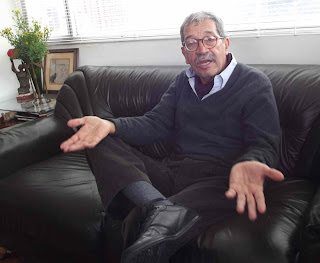
Gonzalo Medina displays a poster about La Ciclovia. 
In 1982, Gonzalo Medina visited Rio de Janeiro and was struck by how the city shut a shoreline avenue to car traffic each Sunday for pedestrians and bicyclists.
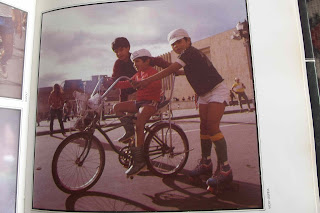
When Medina, then an official with Bogotá's transit department, returned home, he convinced city officials to try the same experiment on the Circunvular, the avenue running along the city's Eastern Hills. But after police complained that the closed road blocked access to a hospital, the new experiment called La Ciclovia was shifted to Ave. Septima.

One of Medina's goals even back then was to change the bicycle's image.

"Riding a bike was not only in bad taste," he said, but cyclists were seen "as people who couldn't afford a Renault."

La Ciclovia way back when. 
Over the following years, La Ciclovia won supporters and confronted opponents, Medina says, including some who wanted to restrict or even eliminate the institution in order to open roads for cars. La Ciclovia overcame its most recent threat several years ago, when a senator introduced a law closing La Ciclovia two hours earlier. The proposal met widespread opposition, including from cyclists and the city's sitting and previous mayors, and the proposal died. Over the years, La Ciclovia has also lost some segments, usually to make way for infrastructure projects.

A scene on La Ciclovía today. 
The Ciclovía concept wasn't born with Medina's trip to Rio. In the early- and mid-1970s a student initiative called the 'mitin de la bicicleta' created a Ciclovia on Avenidas Septima and 13. The idea was formalized by a 1976 decree, but it's not clear to me whether or not it lasted.


Participants in a mass aerobics class, called La Recrovia. 
Since its beginnings La Ciclovia has extended to hundreds of kilometers, added cycling courses and mass aerobics practices called La Recrovia.

The idea has also expanded across Latin America and into the United States, altho Colombia's version is still the largest and most frequent. There's even an International Network of Ciclovias organization to promote the concept. La Ciclovia, along with the TransMilenio express bus network and the city's bike lane network, once gave Bogotá a reputation for progressiveness and urban ingenuity, altho that image has since faded.

Medina says the biggest improvement to La Ciclovia over the years was Mayor Enrique Peñalosa's addition of the annual Ciclovia Nocturna, or night-time Ciclovia.
But the Ciclovia Nocturna happens only once a year, and part of its route is so packed with pedestrians that you can't ride a bike.

More important, it seems to me, is the way that La Ciclovia's become an essential Bogotá institution.

Various studies have found that the Ciclovia concept benefits not only participants' health, but also the economy, by saving on medical expenses.

"I'm proud," Medina says of his work. "It was an important contribution."

In Havana, Cuba, where Medina's wife works for the Colombian embassy, and where he says biking is risky, he continues pushing for better cycling conditions.

But to get more people onto bicycles, Medina believes that bikes mustn't be seen any longer as the 'poor man's vehicle.' In Bogotá, most bicycle commuters are still low income people who ride bikes to save on bus fare. In Colombia's class-conscious culture, the middle class and wealthy want to be seen in cars - even if that means spending hours trapped in traffic jams.

"There should be executives on bikes, so that the bike has status," Medina says.

Medina also advocates more space for pedestrians and cyclists, including car-free streets in the historical center.

Those measures would help Bogotá fulfill more of La Ciclovia's potential - to get Bogotanos to use their bikes not only on Sundays, but every day.

See some videos of Mr. Medina commenting, in Spanish, here, here, here and here.


By Mike Ceaser, of Bogotá Bike Tours

martes, 1 de enero de 2013

Bogotá's Missing Bike Lane - and Missing Bike Planning

 Bicyclists share the road with cars on Carrera 60, which leads to Parque Simon Bolivar.

Carrera 60 has plenty of room for adding a bike lane.
Simon Bolivar Park is Bogotá's biggest green area and very possibly the city's most popular destination for cyclists.

The 26th Street Cicloruta is the city's longest, newest and undoubtedly its most expensive bike lane.

But, altho 26th St. passes within a kilometer of the park, Carrera 60, which connects the two, lacks a bike lane - altho it has ample space to build one.

Why? You'll have to ask the geniuses at City Hall who design these things.
A map of Simon Bolivar Park and some nearby bike lanes.
Sure, you can get to Simon Bolivar Park by bike. One of the city's nicest bike lanes, called Ciclorutas, connects it to the National University along Calle 53 - which begs the question even more strongly why the 26th St. bike lane isn't connected to the park.

And, Carrera 60 connects to Calle 26, with its newly-rebuilt
lane for bikes.
My hunch is that this is the result of the tangle of city entities - parks, transit, the Institute for Urban Development and others, all sticking their fingers into bike lanes planning. And, at least in the past, they did so without the benefit of input from cyclists (altho that may finally be changing). 

Racks for dozens of bicycles in Renacimiento Park,
but I've never seen more than a few bikes here.
Who decided that a 100 cyclists would all want to park
together in this small public park? 
For an even more dramatic example of zany cycle planning, check out this photo of these dozens - or are they hundreds? - of vacant bike parking racks in Renacimiento Park. I took the photo on the New Year's Day holiday while Ciclovia was happening on 26th St., just yards away. I've never seen more than two or three bicycles in this sea of racks (and the park has a second, albeit smaller, equally unused bike rack at its other entrance).

Meanwhile, many important destinations, such as government buildings, banks, supermarkets and many TransMilenio bus stations have no bike parking at all.

Half of Calle 60 does get shut to cars during La Ciclovia, on Sundays and holidays.
A boy bicycles in Simon Bolivar Park. 


A girl bicycles in Simon Bolivar Park. Would she risk sharing a street with cars?
By Mike Ceaser, of Bogotá Bike Tours